


If you’re working toward better management of your earnings and monetary transactions, a financial institution is the best way to begin. Financial institutions are establishments where you can keep your money and access services such as deposits, loans, and investments. Whether you’re opening your first checking account, shopping for a loan, or looking for a safe place to grow your savings, the institution you choose can influence your financial experience for years to come.
Banks and credit unions are two common types of financial institutions, and while they offer similar services and products, they aren’t interchangeable. They differ significantly in structure, purpose, and customer experience.
Banks vs. Credit Unions: The Main Differences
Ownership
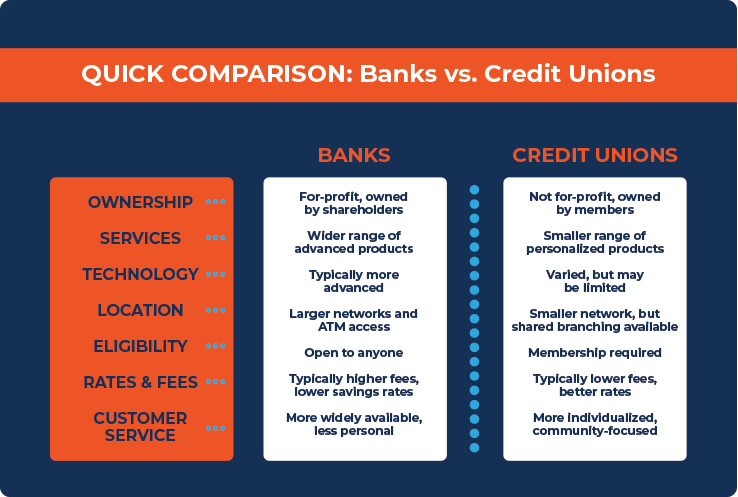
One of the biggest differences between banks and credit unions is who owns them. Banks are for-profit institutions owned by shareholders. Their goal is to generate profit, which can influence fees, interest rates, and product offerings. Anyone can open an account at a bank.
Credit unions, on the other hand, are not-for-profit cooperatives owned by their members. Most credit unions require you to become a member to use their services. When you join a credit union, you are buying a share of ownership in the company for a small fee, often $525. This gives you a voice in way the business operates and voting rights in its leadership. Because credit unions don’t answer to shareholders, they can reinvest profits back into member benefits.
Financial Benefits
Credit unions are widely known for offering better financial value to their members. Since credit unions aren’t focused on making a profit, they can use the income they generate to offer lower loan rates, higher savings rates, fewer fees, and more flexible lending criteria.
Banks may charge higher interest on loans and higher fees for account maintenance and overdrafts than their credit union counterparts. However, banks sometimes provide more robust credit card rewards programs, promotional bonuses, or specialized financial products that credit unions may not offer.
Convenience
Convenience is one area where banks often have the upper hand. Banks, especially national ones, often offer a more extensive network – meaning more branches, greater ATM access, longer hours, and more advanced online services. The widespread availability of most banks may make it easier to make transactions when you need to. Banks may also be quicker to roll out new apps or online services.
Credit unions, by contrast, may not offer as many physical branch locations or ATMs, but many share branches via a network, allowing you more flexibility for in-person transactions. This can significantly expand access, especially for people who travel frequently or move often. Some smaller credit unions may not offer advanced technology on their websites or mobile apps. However, many national credit unions offer strong mobile services. The quality of apps and digital tools can vary.
Range of Services
Both banks and credit unions offer the core financial services most people need, including checking and savings accounts, loans, credit cards, and mobile banking. However, the breadth and specialization of their offerings can differ quite a bit.
Banks can often accommodate larger loans and offer a wider range of products, such as wealth management, international banking, and a wider variety of loan products.
Credit unions may offer fewer specialized services, but they often excel in personalized lending, especially for small businesses or individuals who may not qualify for traditional bank loans. They may offer more flexible lending criteria and be more willing to work with members who have limited credit history.
Customer Support & Community Focus
Credit unions tend to be more community-oriented and typically limit membership to those living within the same community, or “field of membership,” which could be a workplace, geographic area, or school. In return, credit unions often focus on supporting local businesses and community institutions. Credit unions often develop more personal relationships with members, and tend to score higher in customer satisfaction surveys.
While credit unions still have membership requirements, these have become much more flexible. Many now allow anyone to join by living in a certain area, working for a partner employer, or making a small donation. This means that credit unions are more accessible today than ever before.
Banks, especially large ones, may offer efficient service, but it may be less personalized. However, banks often provide 24/7 customer support, chatbots, and online help centers, which can be a major advantage for people who prefer digital communication or need assistance outside of business hours.
Safety
Both banks and credit unions are equally safe places to keep your money. Deposits are insured up to $250,000 per depositor, per ownership category: banks are insured through the Federal Deposit Insurance Corporation (FDIC) and credit unions are insured by the National Credit Union Administration (NCUA). This insurance protects your money even if the institution fails.
How To Choose Between a Bank and Credit Union
Choosing between a bank and a credit union ultimately depends on your financial needs and priorities. Both types of institutions are safe, regulated, and capable of meeting everyday banking needs, but they shine in different areas.
It can also help to think about your upcoming financial needs. For example:
-
If you’re planning to apply for a mortgage or auto loan, comparing rates between institutions can make a meaningful difference in long-term cost.
-
If you’re opening your first account or rebuilding credit, a credit union’s flexible lending criteria may be helpful.
-
If you run a business or need specialized financial tools, a bank may offer more robust options.
-
If you rely heavily on mobile banking or need 24/7 customer support, a bank may be more aligned with your lifestyle.
This doesn’t need to be an either-or decision. Some people use both for different purposes. The best choice is the one that aligns with how you bank, how you borrow, and what kind of financial relationship you want to have.

WITHU INSIGHTS TEAM
WithU Insights is powered by a team of writers and strategists who are passionate about sharing our knowledge of the ever-changing financial landscape. Through educational articles and resources, we aim to empower you to navigate your finances and life with purpose.