

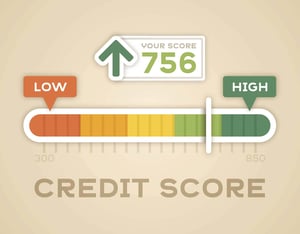
Your credit score can have a major impact on your finances and your future opportunities, so increasing that number can make a real difference. But reaching a good score is only part of the process—you also need to maintain it. You don’t want to do all the work of achieving a good credit score only to lose it, so let’s take a look at what you can do to keep your score on track.
What Is a Good Credit Score?
The term “credit score” usually refers to either your FICO® score or your VantageScore.
FICO (Fair Isaac Corporation) is the most common credit score used in lending and business, and it ranges from 300 to 850, with a lower score indicating a higher risk. Too low of a credit score could cause lenders to deny a loan application or only approve it with much higher interest rates.
Here’s a quick breakdown of FICO score ranges:
-
Exceptional: 800+
-
Very Good or Above Average: 740-799
-
Good: 670-739
-
Fair: 580-669
-
Poor: 300-579
According to Experian, as of September 2025, the average credit score in the U.S. in 2025 was 713, with 22.8% having a score between 800-850, 27.5% between 740-799, 20.1% between 670-739, 14.9% between 580-669, and 14.7% between 300-579.
FICO credit scores are based on five main factors:
-
Payment history (35%) — Your track record of past payments
-
Amounts owed (30%) — The percentage of available credit that you’re using
-
Length of credit history (15%) — How long your accounts have been open
-
Credit mix (10%) — Your mix of credit cards, retail accounts, installment loans, and mortgage loans
-
New credit (10%) — How many applications to lines of credit you’ve submitted in the past 1-2 years
How Do You Find Out Your Credit Score?
As the Consumer Financial Protection Bureau points out, your free credit report won’t have your actual credit score on it.
You can request your reports from all three major credit bureaus — Equifax, Experian, and TransUnion. In some cases, getting your score from these companies may require a fee and each one only uses one model for calculating your score, either FICO or VantageScore. Important to note that the score you access may not be the same as the one lenders use.
How Do You Maintain a Healthy Credit Score?
Keyword for this section is: maintain. While some of these steps can also help with initially building your credit, that’s a separate topic that we’ve covered in another article. Here, we’re going to look at what you should be doing once you’ve gotten your score to a good point — ideally, 700 or above.
Pay your bills on time every month.
This is the big one because, remember, your payment history accounts for 35% of consideration for your FICO score. So consistently paying your bills and making your credit card and loan payments are key to keeping your score up. Even if you can’t pay off the full balance of your credit card that month, paying at least the minimum balance on time helps. If you can set up automatic payments, that can be extremely useful.

Keep an eye on your credit limit.
Credit utilization is about the percentage of your limit you’re using, not the total dollar amount you owe.
If you have a very high credit limit, you might have a very high credit card bill that the credit bureaus don’t have an issue with because it’s a low percentage of the overall usage.
For example, having a $3,000 balance on a $10,000 limit (30% utilization) is generally fine. But that same $3,000 balance on a $4,000 limit (75% utilization) could hurt your score.
A common guideline is to keep your balance below 30% of your credit limit.
Only apply for a new credit line when you need it.
Applying for several loans or credit cards in a short period can be a red flag for lenders. It may signal financial strain, which makes you higher risk, or lead to multiple hard credit checks, which can negatively impact your score.
Check and audit your credit reports at least once a year.
The Consumer Financial Protection Bureau recommends fact-checking your own credit record when you get your free annual reports. This helps you understand where you stand, identify areas for improvement, and catch errors or potential fraud early so you can dispute them.
Establish an emergency savings fund.
This one doesn’t directly affect your credit score on a day-to-day basis, but it can be a lifesaver in a crisis. If you have a savings account and/or an emergency fund, you’re more likely to be able to cover a sudden financial crisis or setback, putting you in a better position for maintaining your good credit.
Slow, Steady Habits Are Your Friend
Building and maintaining a good credit score is about patience and consistency. Establish healthy financial habits and stick with them month after month.
You may have missteps — like a late electric bill or an extra high credit card balance — but your long-term path and patterns are what’s most important. Stick with your good habits, and your credit score will follow.

WITHU INSIGHTS TEAM
WithU Insights is powered by a team of writers and strategists who are passionate about sharing our knowledge of the ever-changing financial landscape. Through educational articles and resources, we aim to empower you to navigate your finances and life with purpose.